08 Aug 2026
Emirates Boarding Groups Explained: A Complete Guide

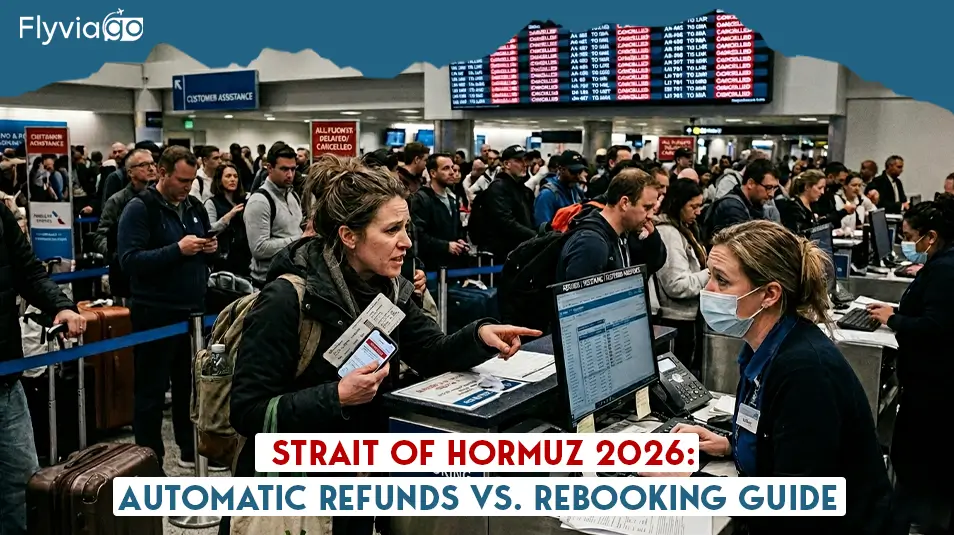
The Middle East is facing the challenges of the ongoing geopolitical crisis, exacerbated by the war tensions between Iran, the US-Israel strikes. It led to the Hormuz airspace closure 2026, affecting the global aviation. The narrow passage of the Strait of Hormuz is responsible for approximately 20% of the world?s oil and LNG supply, has been facing a traffic halt that increases the tension of fuel supply, safety risks from direct military activity, which ultimtely led to the suspension of major flights in the Middle East.
As of April 2026, major carriers like Lufthansa, British Airways, and Cathay Pacific have officially extended their flight suspensions to Middle East hubs (Dubai, Doha, Tel Aviv) until May 31, 2026. This has left the passengers in a dilemma whether to rebook their flight or opt for an automatic refund. Both options fall under the airline?s policies and passengers? rights, but the difference is in the cost, timing, and flexibility. This guide will help the passengers make informed decisions with the official airline?s statement, EU passengers? rights, and real-time updates and reports.
Related Reading: Air Albania Operations Suspended: What You Need to Know
The Strait of Hormuz acts as a bridge between the Persian Gulf to Arabia Sea and a major checkpoint to the global energy. The retaliation of Iran against Israel and the USA has escalated the threats and the blockades have halted the tanker traffic, leading to the jet fuel shortage April 2026, which contributed to the escalation of fuel prices, and forced the aviation insurers to increase the premiums to withdraw coverage for overflights. Due to the combined and direct airspace closure in the UAE, Qatar, and Israel, has terribly affected the routine operations for safety and logistic reasons.
Continuing the operation under such conditions can risk the life or passengers and crew members, especially flights operating into Dubai (DXB), Doha (DOH), or Tel Aviv (TLV). While rerouting can be an option that adds the fuel prices and hours. The major hubs in the Gulf that connect Europe-Asia and Europe-Africa are closed as of now. The recent data shows that the aviation industry facing a cancellation of over 1800 flights daily.
This situation comes under the special circumstances, where the airline is not liable for compensation, but they must provide a full refund or rebook the tickets without charging extra.
A number of major airlines have further suspended flights to major Middle Eastern airports like Dubai, Doha, and Tel Aviv. The decision is informed by several factors, which are interrelated such as safety risks, logistical issues, and monetary factors.
The shortage of jet fuel in April 2026 is one of the biggest problems that have exacerbated the effect of limited airspace. The disruptions in the fuel supply in the region have made airlines to rethink their operations as longer routes will need more fuel, which adds cost and uncertainty.
Also, airlines are under pressure to ensure that they keep their passengers safe as well as reduce operational risks. As the geopolitical environment keeps on being unstable and changing, and as airlines will be able to avoid cancellations at the last moment, extending suspensions will enable airlines to have more control over their schedules.
These protracted suspensions have also contributed to higher prices of tickets and other expenses for passengers. Airlines are revising fares to cover increased operating costs, such as airline fuel surcharge April 2026, now a common element of rebooked itineraries.
In the event that flights are canceled because of reasons such as the Hormuz Flight Suspension, the passengers are usually entitled to a refund. The procedure and eligibility requirements however, can differ depending on the airline and the type of ticket.
The Hormuz flight cancellation refund policy is usually applicable in such a way that the passengers get back all the money in case the airlines cancel the flight. This is the base fare plus any other taxes and fees. The refunds are typically carried out with the same payment method as the initial payment, but certain airlines can also provide travel vouchers.
It should be mentioned that it can take several weeks to have the refund because of high rates of cancellations. The passengers also need to examine whether they have booked with the airline or with a third-party agency, as this may influence the refund procedure.
The other important factor would be whether the cancellation was voluntary or involuntary. Refund eligibility can be determined by the rules of fares and airline policies, in situations when the passengers decide to cancel their trip because of safety issues.
Rebooking is a good alternative to those travelers who have not yet completed their journey. Airlines are also providing flexible rebooking policies to accommodate affected customers so that they can shift travelling dates or routes without any major penalties.
Nonetheless, rebooking with the Middle East travel disruption 2026 might be tricky. There is a lack of flight capacity, increased demand, and fewer routes, so that the passengers might not have as many options as they would.
Re-booked flights in most instances may be longer journeys or have more stopovers. It is advisable that passengers are thorough in reading their new itineraries to make sure they are able to fulfill their travel requirements. Although the airlines can waive the change fees, there can be an increment in the fare differences, particularly where the ticket prices are higher now.
Rebooking cost has also been affected by the introduction of airline fuel surcharge April 2026. There is a possibility of paying higher fares as a result of higher fuel costs, despite the base fare staying the same.
|
Feature |
Automatic Refund |
Rebooking / Alternative Routing |
|
Best For |
Travelers who want their money back and prefer to cancel their plans entirely. |
Travelers who still need to reach their destination and can tolerate delays. |
|
Speed |
7?20 days depending on local regulations and payment method. |
Highly variable; many carriers are currently overwhelmed with backlogs. |
|
Cost |
Full refund of the original fare (no cancellation fees under current mandates). |
Usually free, but availability is extremely limited in the Gulf corridor. |
|
Control |
High; you get your capital back to book elsewhere. |
Low; you are dependent on the airline's partner network and seat availability. |
The decision to refund or rebook is based on a number of factors such as the urgency of the travel, the budget and individual preferences.
The most appropriate solution is a refund, where the passengers have changed their mind to proceed or even to wait till the situation is stable. It offers financial freedom and does not give the uncertainty of constant disruptions.
Rebooking, on the other hand, is perfect with travelers who have pressing plans or non-refundable plans to the destination. Although it can be more expensive and inconvenient, it will enable the passengers to resume their journey with minimal inconvenience.
The broader implications of the Hormuz airspace closure 2026 should also be considered by the passengers because restrictions could still be in place even after they rebook flights. The information about updates on airlines and aviation authorities should be monitored to make informed decisions.
The Hormuz Flight Suspension is not a one-time occurrence- it has far-reaching impacts on international travel. This is especially relevant to airlines that fly routes across Europe, Asia, and the Middle East as they are very dependent on this corridor.
Among the greatest effects are the increased travel time. Flights that once flew straight are now forced to fly further routes, thereby causing delays and inefficiency. This has led to the shortage of jet fuel in April 2026, whereby the demand for the fuel increases with an increase in the duration of flights.
The suspension has also impacted cargo operations, which have led to a rise in the costs and transportation of goods in supply chains. This also spills over to industries that rely on timely deliveries, and again, the significance of stable airspace is noted.
The EASA conflict zone advisory has remained a very crucial part of steering the airline operations. It assists airlines in making sound decisions concerning routing and safety, as it identifies high-risk areas, even when it causes temporary disruptions.
Travel disruptions are stressful, but there are a few steps that passengers can follow to cope with the situation:
The Strait of Hormuz is a dynamic situation, and its effects on aviation will probably continue to change. Although airlines have already extended their suspensions through May 31, 2026, they can not be dismissed.
The Hormuz airspace shutdown 2026 will be highly reliant on geopolitics and how well countries can stabilize the region. Meanwhile, airlines will still focus on safety and efficiency in their operations even when it could result in protracted disruptions.
Rising issues connected to the jet fuel crunch in April 2026 and volatile ticket prices are also something the passengers should be ready to face. As airlines evolve to meet the new environment, it will be about flexibility and being ready to face the new traveling environment.
Table Of Content
All Categories